
CHFN review is most effective when built around confused-concept pairs and applied paper scenarios. Trace each pair (phenotype, class vs stage, marker vs symptom, education vs dose advice) through a worked example, note the plausible mistake, and retest until you can state the boundary rule from memory. End each study block by writing a two-line case of your own and checking it against a rubric.
Separating HFrEF, HFmrEF, and HFpEF When a Case Gives Only Numbers
Phenotype labels describe three different left ventricular ejection fraction patterns with different management themes. When a paper case gives a percentage, map it to the phenotype category it falls into, then ask what that category changes for assessment and education focus.
Trace this example: a case states EF 45% with orthopnea and an S3. A plausible mistake is reading '45' as roughly normal because it sits near the middle of the scale, then skipping the mildly reduced category entirely. The better decision is to anchor on the category language heart failure education commonly uses — reduced, mildly reduced, and preserved — and place the number before interpreting anything else. If you cannot place it, note that uncertainty explicitly rather than forcing a label.
This matters because the phenotype shapes everything downstream in a case: which management themes deserve attention, which device-related topics are relevant, and which education priorities fit. Review each category with the same three prompts: what the number generally means, what the whole clinical picture must include, and what review content follows. Compare your written answer across all three categories side by side; differences between your answers reveal where the concept boundary is still blurry for you.
- Reduced EF: focus review on guideline-directed therapy concepts and device-related themes.
- Mildly reduced EF: treat as its own category, not a middle default, and check what the case emphasizes.
- Preserved EF: review congestion management and comorbidity themes; do not infer a normal study from it.
| Feature | Reduced EF | Mildly reduced EF | Preserved EF |
|---|---|---|---|
| General number placement | Low end of the range | Between reduced and preserved | Upper end of the range |
| Boundary rule to memorize | Number below the reduced range | Number in the middle band | Number in the upper band with symptoms |
| Common case phrasing | Dilated ventricle, low EF | EF described as mildly reduced | Normal EF with congestion findings |
| Review focus after labeling | Therapy and device themes | Category-specific management themes | Congestion and comorbidity themes |
NYHA Class Versus ACC/AHA Stage: Two Scales You Must Not Merge
NYHA class describes current symptom burden and can move in both directions with treatment and disease change. ACC/AHA stage describes structural disease history and only advances. Confusing the two corrupts both trend documentation and case interpretation.
Trace this example: a patient is admitted in NYHA class IV, improves to class II on therapy, and is discharged. The plausible mistake is writing 'now Stage B' because the patient feels better. The better decision is to keep the stage where its history places it — a patient with known structural disease and prior decompensation remains stage C — while documenting that the class improved to II. Class is a snapshot of today's symptoms; stage is a one-way summary of disease history.
This distinction matters because exam-style cases and real documentation both rely on trends. If a note says a patient moved backward in stage after treatment, the reader cannot tell whether the patient deteriorated or the writer merged two scales. Drill it with paired statements: write five sentences about a patient using only class language, then five using only stage language. Any sentence that mixes 'improved stage' or 'worsened stage from symptoms' signals the pair is not yet clean in your notes.
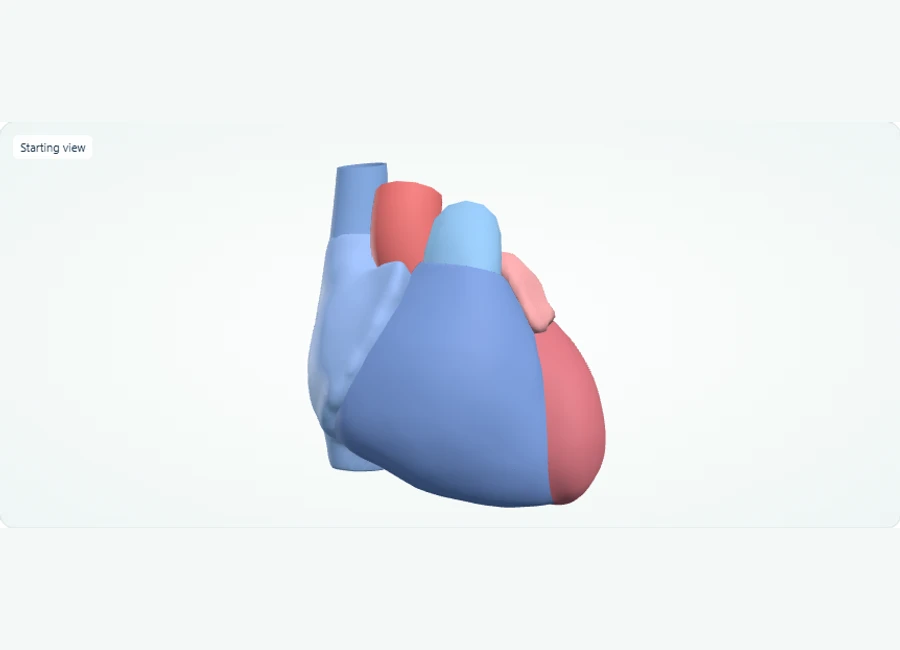
Explore in 3D: Heart chambers and great vessels
A four-chambered heart viewed from the front. The right ventricle supplies the pulmonary circulation via the pulmonary trunk; the left ventricle supplies the systemic circulation via the ascending aorta. This model shows external chamber surfaces and the visible great vessels only — no internal valves or conduction system.
Rotate, isolate structures, and test your recall.
Choose Front and compare the four chambers. The right ventricle forms most of the anterior surface; the left ventricle contributes to the apex.
Select and isolate each chamber in turn, then use Show all to restore its relationship to the surrounding structures.
Select the pulmonary trunk and ascending aorta in turn. Name the circulation supplied by each, then use Test recall to practise identifying the listed structures.
Try it yourself
Which ventricle supplies the pulmonary trunk, and which supplies the ascending aorta?
Show answer and explanation
The right ventricle; it serves the pulmonary circulation.
On the front view, the right ventricle is the anterior-most chamber, and its outflow tract continues as the pulmonary trunk carrying blood to the lungs. The left ventricle instead empties into the ascending aorta for the systemic circulation.
- The right ventricle pumps blood into the pulmonary trunk toward the lungs; the left ventricle pumps into the ascending aorta to the body.
- The superior vena cava returns blood to the right atrium from above the heart.
- The two atria sit superior to the two ventricles; atria receive blood, ventricles eject it.
Reading Natriuretic Markers With the Bedside, Not Instead of It
Brain natriuretic peptide values support heart failure assessment but do not stand alone. Many factors move the level, so a paper case should be interpreted as marker plus symptoms plus trend, never as a single number that decides decompensation.
Scenario: an outpatient's follow-up shows a mildly elevated natriuretic peptide with no reported symptoms, stable weight, and clear lungs on the documented exam. A plausible mistake is declaring decompensation from the value alone and recommending escalation. The better decision is to interpret the value in context: check the documented trend, the weight record, the renal picture if given, and the symptom report, then treat the marker as one input among several. Where context is missing, the correct case answer is usually to gather more information rather than to act on the number.
Practice the boundary with a short exercise: list three factors that can raise a natriuretic peptide without decompensation — for example, age, reduced kidney function, and certain rhythm disturbances — and write one sentence explaining why each breaks a single-number interpretation. Then invert it: write a case where a normal value coexists with obvious congestion. If your two sentences look symmetrical, you have the concept; if you trusted the number in either direction, rework the pair.
Applied Decision-Making: Congestion Signals in Home and Clinic Cases
Congestion recognition combines weight change, breathing effort, and edema findings into one interpretation. Paper scenarios test whether you escalate a cluster of small findings rather than dismissing each one in isolation.
Scenario: a home-visit case shows a 2.3 kg weight gain over three days, new dyspnea climbing one flight, and pitting ankle edema documented for the first time. The plausible mistake is attributing the weight to a salty meal, scheduling the routine next visit, and moving on. The better decision is to name the cluster as a congestion signal, contact the prescriber for direction, review the diuretic instructions already on record, and document the findings and the notification. No single finding forces that call; the combination does.
This matters because clustering is exactly the skill a single-recall review cannot build. Use a timed self-check: pick any case, and within two minutes write four lines — findings, interpretation, decision, escalation step. A correct pattern looks like '2.3 kg in 3 days + new edema + exertional dyspnea → congestion suspected → notify prescriber today → document patient response.' If your pattern starts with a lab value instead of the bedside cluster, redo the check with a different case until the order feels automatic.
- Weight gain plus new edema plus exertional dyspnea is one interpretation, not three notes.
- Escalation means notifying the prescriber, not adjusting doses independently.
- Documentation should record the cluster, the notification, and the patient's response.
Documentation Practice: Writing Notes That Stand Alone
Exam-style and real-world documentation both reward notes a later reader can reconstruct without asking you. The habit to train is converting a vague impression into structured findings, interpretation, action, and response.
Compare 'patient did well today, continues to have some swelling' with 'weight 2.3 kg above last visit; 2+ bilateral ankle edema, new; dyspnea at one flight, new; prescriber notified; patient verbalized plan to elevate legs and take medications as prescribed.' The second version survives a handoff. The plausible mistake in practice is writing the impression without the elements that justify it, which leaves the reader unable to distinguish stability from an early signal.
Run this rewriting exercise three times during preparation: take any vague sentence from your own notes or a case, expand it into the four elements — objective findings, interpretation, action taken, patient response — then check it with a rubric. A note passes when every claim has an observable anchor, the interpretation names the suspicion explicitly, the action names who was contacted, and the response quotes or paraphrases the patient. If any element is missing, the exercise is not finished; repeat with a fresh sentence until four out of four feels routine.
- Rubric line 1: every statement has an observable finding behind it.
- Rubric line 2: the interpretation names the suspicion, not just the data.
- Rubric line 3: the action names who was contacted and when.
- Rubric line 4: the patient response is recorded in the patient's terms.
Ethics and Safety Boundaries: Education Versus Dose Advice
Heart failure nurses educate on the prescribed plan and recognize symptoms, but dose changes belong to the prescriber. Cases test whether you reinforce the plan, escalate the symptom, and document — without crossing into independent adjustment.
Scenario: a patient calls before a family event, says her legs are swollen, and asks whether she can take an extra diuretic dose 'just for tomorrow.' The plausible mistake is agreeing, because the intent is helpful and the request sounds reasonable. The better decision is to stay on the boundary: reinforce that doses are taken as prescribed, report the new swelling through the correct channel, provide the education already established for symptom flare-ups, and document the call and the escalation. The symptom gets acted on; the dose decision does not get made by the nurse.
The boundary matters in both directions. Refusing to discuss the medication at all under-educates; agreeing to the adjustment oversteps. Train the middle path with paired scripts: what you say to the patient (plan reinforcement, symptom report, no dose change), and what you say to the team (findings, request, notification). Write both scripts for three different cases — a missed dose, an extra-dose request, a side-effect report — and check that each pair ends with the prescriber, not with an invented rule.
A Six-Step Preparation Sequence and Concrete Readiness Checks
A workable sequence alternates concept pairs, case application, and self-checking, with the ambiguous edges saved for the end. Aim for cycles you can repeat, not one long pass, and finish when the readiness checks below hold without notes.
One adaptable sequence: week one, build a concept-pair sheet covering phenotype categories, class versus stage, and marker versus symptom. Week two, write and solve ten short paper cases, five for volume status and five for boundaries like dose advice. Week three, drill documentation by rewriting notes against the rubric. Week four, mix pairs at random and retest; week five, target whatever the log still flags; week six, run the full readiness check and only review what fails it.
Readiness checks, treated as learning milestones rather than pass predictions: you can state the boundary rule for all four concept pairs from memory; you can solve a volume-status case in under two minutes with the four-line pattern; your rewritten notes score four out of four on the documentation rubric twice in a row; and your case log shows your first instinct and the better decision agreeing on new cases. One short administrative note: eligibility, scheduling, and credential requirements are set by AAHFN, and administrative details should be confirmed directly with the issuer rather than inferred from study materials.
- Weeks 1–2: concept-pair sheet plus ten written cases.
- Weeks 3–4: documentation rubric drills, then randomized mixed retests.
- Weeks 5–6: targeted review from your log, then full readiness check.
- Keep a disagreement log: every case where instinct and better decision split.
References and further reading
Use these references to explore the concepts and check the latest information from the relevant organizations.