
Treat the CBET as a judgment exam. Study each device class as a chain of testable behaviors, practice classifying safety-test results as fault or artifact, and rehearse repair-versus-escalate decisions on paper until you can explain every choice in one sentence a supervisor would accept.
Connecting Electronics, Physiology, and Procedure in One Study Unit
The CBET syllabus spans electrical theory, device function, and facility procedure. Build study sessions around connecting them into one defensible decision rather than memorizing component facts in isolation.
A useful study unit is the device-behavior chain: for any equipment class, define what the device is supposed to do physiologically, what electrical or mechanical subsystem produces that behavior, what a test would measure to confirm it, and what document records the result. When you study an ECG monitor this way, lead placement knowledge, differential amplifier behavior, and electrical safety limits all attach to one coherent object instead of floating separately.
This framing also changes how you use practice questions. Instead of checking whether your answer matched the key, ask what principle each question was probing and write that principle in your own words. Over a few weeks your notes become a map of decision rules—when to trust a reading, when to re-test, when to escalate—rather than a pile of definitions. That map is what you carry into scenario-style items.
Telling Leakage Current Types Apart Without Mixing Up Test Points
Ground, enclosure, and patient leakage currents differ in where current escapes and which conductor the analyzer intercepts. Learn each test's connection point and measurement path, because that distinction drives both the reading and the acceptability judgment.
Ground leakage current flows in the protective earth conductor and is measured by interrupting or intercepting that conductor path. Enclosure leakage current flows from the accessible chassis to ground and is measured by placing the analyzer lead on exposed conductive surfaces. Patient leakage current flows through patient-applied parts and is measured in the leads or connections intended to touch the patient. Three different test points, three different escape routes, and one analyzer you must set up correctly each time.
A practical drill: take five device classes—electrosurgical unit, defibrillator, infusion pump, patient monitor, examination light—and for each write which leakage category you expect to be most relevant and where the analyzer lead goes. Patient-applied devices pull your attention to patient leakage; chassis-only devices emphasize enclosure leakage; a device with a compromised earth path shows up in ground leakage. If you can justify the expected category before testing, the measured value becomes confirmation rather than surprise.
In a labeled worked example only: suppose your departmental procedure states an enclosure leakage acceptance threshold of 100 microamps, and a monitor with no patient connections reads 120 microamps on the chassis. The judgment is not just 'over the number'—it is that an enclosure measurement on a non-patient-contact device implicates chassis-to-ground isolation, which changes your next step toward internal inspection or removal from service rather than lead-set replacement.
Illustrated practice: Intracardiac Conductors and Leakage Current Risk in the Cath Lab
Shows the route of an intracardiac conductor from outside the body through the venous system to its endpoint inside the right heart, grounding the microshock hazard in the visible anatomy of the low-resistance current path.
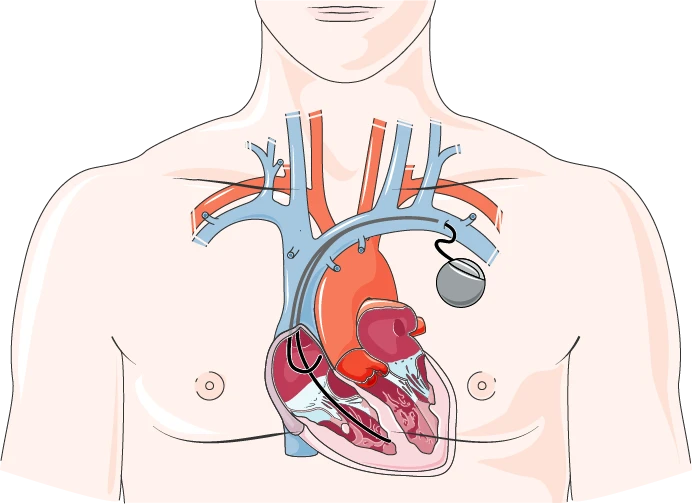
Anatomical study exhibit for the worked question below. Open the full-size view to inspect the structures.
Use the anatomical exhibit to work through the example. Choose an answer before opening the explanation.
Try it yourself
During a safety inspection in the cardiac catheterization lab, a pressure monitor connected to a patient with an intracardiac pressure line measures leakage current above the permitted limit for patient-connected equipment. The educational exhibit shows the route of a transvenous pacemaker lead from a chest generator into the heart. Use it as an anatomical reference for how an intracardiac conductor bypasses the skin barrier; it is not an image of this patient or the pressure line. Which risk should the technician treat as most urgent? A. Alarm and data corruption on the monitor, because excess leakage current indicates failing digital circuitry throughout the device. B. Macroshock to nearby staff touching the chassis, because chassis leakage indicates a severe institutional wiring fault. C. Microshock through the intracardiac conductor, because small currents applied directly to the heart can trigger ventricular fibrillation. D. Interference with other lab equipment, because leakage currents primarily disrupt imaging and recording systems nearby.
Show answer and explanation
C. Microshock through the intracardiac conductor, because small currents applied directly to the heart can trigger ventricular fibrillation.
As the schematic shows, an intracardiac conductor terminates inside the right heart chambers rather than on the skin surface. An intracardiac conductor bypasses skin resistance, so minute leakage currents reach the myocardium directly and can induce fibrillation at far lower levels than external shock thresholds. Staff macroshock and equipment interference involve higher current paths and are secondary here.
Reading a Failed Safety Test: Real Fault or Setup Artifact?
A failing number is a claim, not a conclusion. Before acting, verify the test setup, the device state, and repeatability—then classify the result as a reproducible fault requiring action or an artifact of the measurement itself.
Artifacts come from predictable places: an analyzer lead attached to painted or anodized metal instead of bare conductive surface, a device left in standby when the procedure requires full operating mode, or a patient cable connected when the test specification calls for open-circuit leads. Each of these changes the measurement path, and each is cheaper to rule out than to misdiagnose. Keeping the path straight in your notes pays off here: upstream issues such as a worn wall receptacle or power strip can distort measurements that run through the outlet circuit, such as leakage tests, but they cannot explain a pin-to-chassis bonding result.
Scenario 1 (worked): during annual safety testing, an examination room monitor fails the analyzer's ground resistance (protective earth bonding) check. The plausible mistake is to tag the monitor out and open a repair order for internal power supply work, assuming a bonding failure somewhere inside the chassis. The better decision is to inspect the actual measurement path first: the analyzer contact point on the chassis (bare metal versus painted or anodized surface), the plug's protective earth pin for damage or pitting, and the cord for conductor faults. In this example, inspection reveals a damaged plug earth pin, so the corrective action is cordset or plug replacement with a documented retest—not internal surgery. Why it matters: the bonding test runs from the plug pin to the chassis, so locating the fault outside that path sends the repair to the wrong place and records a failure against the wrong subsystem.
Repair, Replace, or Escalate: Structuring Equipment Decisions
Sound maintenance decisions weigh safety impact, clinical urgency, serviceability, and cost against defined criteria rather than instinct. Build a personal decision table now, then practice applying it to exam-style cases until the reasoning feels routine.
Risk-based maintenance thinking helps here. Devices are commonly grouped by how a failure would affect patients: life-support and critical-care equipment sits at the top, diagnostic and monitoring equipment in the middle, and non-patient-contact conveniences lower down. That grouping informs inspection frequency, how quickly a failed unit must be addressed, and whether a temporary substitute device must be deployed while service proceeds. Learn the grouping logic and be able to place any device class into it with a stated reason.
The second half of the skill is the repair-versus-replace-versus-escalate choice. Escalate when the fault involves radiation, sterility, or a subsystem your training does not cover; replace when cumulative repair cost and downtime approach replacement value and no safety gain comes from continuing to repair; repair in-house when the fault is within your competency, parts are available, and post-repair verification can be completed and documented. The table below makes the trade-offs explicit.
| Decision | Supporting conditions | Typical next step | Documentation required |
|---|---|---|---|
| Repair in-house | Fault understood; competency covers it; parts on hand; verification test available | Service, run full function and safety verification, return to service | Fault description, parts used, test results, technician ID, date |
| Send out / escalate | Radiation, sterility, or specialized subsystem beyond local competency; vendor contract applies | Tag out, arrange vendor service, deploy substitute if clinically urgent | Tag details, referral record, substitute device assignment |
| Replace | Repeated failures, repair cost near replacement value, parts obsolete | Submit capital or replacement request through facility process | Repair history summary supporting the request |
| Retest and monitor | Single ambiguous reading; artifact suspected; device clinically needed short-term | Correct setup, retest, if borderline label for shortened re-check interval | Both readings, setup notes, monitoring plan |
Writing Service Documentation That Answers the 'Why' Behind Every Action
A defensible record shows what was observed, what standard or procedure informed the action, what was done, and how the device was verified afterward. Practice writing entries that a reader could reconstruct without asking you anything.
Compare two entries for the same job. 'Checked pump, works fine, PM complete' tells a reviewer nothing testable. 'Pump occlusion alarm verified with test syringe at set occlusion pressure; flow rate verified against graduated cylinder at three settings; enclosure leakage measured within procedure limit; battery runtime below procedure threshold—battery replaced, runtime reverified' names the observation, the method, the failing value, and the corrective action with re-verification. The second entry is the shape of a defensible record, and it is the shape your written scenario answers should take.
Professional standards also enter through scope-of-practice and ethics questions. The recurring principle is that a technician reports and refuses to bypass what they cannot verify: never defeat an alarm to move a device back into service, never sign verification for a test not actually run, and route concerns about device safety upward through the defined chain even when the fault is inconvenient for the schedule. These are decision rules you can rehearse with short written cases, not just attitudes to hold.
Worked Scenario: An Infusion Pump That Alarms Without an Occlusion
Intermittent faults test whether you separate hypothesis from evidence. The disciplined sequence is reproduce, isolate, verify, document—an alarm with no visible cause still demands a documented disposition, never a silenced device.
Scenario 2 (worked): a nurse reports that an infusion pump periodically alarms for downstream occlusion even though the line is clear and flow appears normal. The plausible mistake is to accept the field condition at face value and either order a pump replacement for an unconfirmed fault or clear the alarm and return the pump to the floor with no testing. Both skip the step that makes the decision defensible: reproducing the symptom under controlled conditions.
The better sequence: attach a test setup that lets you apply controlled back-pressure downstream and confirm the pressure sensor trips at the specified threshold; then inspect the door latch and tubing path, since intermittent latch or sensor contact faults commonly mimic occlusion alarms. Suppose the pump reproduces the alarm only when the door is flexed—that isolates the fault to the door interlock or sensor alignment, not the pressure sensing. Why it matters: the disposition now changes from 'unreproducible complaint' to a specific repair with a specific verification test, and the record shows exactly what was reproduced, what failed, and what was retested before return to service.
A Preparation Sequence and Readiness Rubric You Can Score Yourself Against
Structure preparation as a cycle across device classes rather than a march through topics. Each cycle: review theory for one device class, run the testing logic on paper, write one scenario disposition, then score it against the rubric below.
A realistic adaptable sequence: spend cycle one on electrical safety testing fundamentals—the three leakage categories, ground continuity, and analyzer setup logic. Cycle two covers monitoring and diagnostic devices, attaching physiology basics to each device's function. Cycle three covers therapy and life-support classes, where risk grouping and urgency reasoning dominate. Cycle four covers procedures, documentation, and ethics cases. Cycle five is scenario drilling: write full dispositions using the repair-decision table and score them. Adjust the number of cycles to your schedule; keep the cycle structure intact.
Practical exercise with expected observations: pick three devices from your own environment or from descriptions, and for each write a one-page sheet answering—expected dominant leakage category and test point, the two most informative function tests, the risk group with justification, and one plausible artifact you would rule out before calling a failure. Expected self-check: by the third sheet you should be writing the artifact section without hesitation and citing a specific procedure step for each test rather than a vague 'follow safety protocol.'
Readiness rubric (learning milestones, not pass predictions): score each written disposition 0–2 on four axes—correct classification of the fault or artifact, correct choice among repair, escalate, replace, or retest; completeness of the documentation plan; and stated verification step. A total of 6 or better across repeated scenarios, with all four axes at least 1, suggests you are building the reasoning pattern scenario-style practice develops. Scores below that tell you which axis to drill, not whether you will pass.
One administrative note: credential requirements, eligibility, and scheduling for the CBET are set by the credentialing organization—confirm current details directly with AAMI rather than relying on secondhand summaries.
References and further reading
Use these references to explore the concepts and check the latest information from the relevant organizations.