
Prepare for the CAA exam by studying anesthesia knowledge as connected decisions, not isolated facts. Attach every drug, physiological value, monitoring pattern, and professional standard to a running case narrative, then test yourself by predicting how the case changes when one variable changes.
The Anesthesia Triad: Why 'Depth' Is Not a Single Number
Anesthesia is usually taught as three separable targets: hypnosis (unconsciousness), analgesia (absence of pain response), and immobility or muscle relaxation. A core study habit is asking which target each intervention addresses.
Begin by naming the triad in your own words and assigning each component a different drug family: hypnotics and volatile agents target hypnosis, opioids target analgesia, and neuromuscular blocking agents target immobility. When you review any anesthetic plan, write which target each drug serves. This habit prevents a common reasoning error when working through anesthesia scenarios: treating a patient's movement, a hemodynamic response, or a lightening of consciousness as the same problem with the same fix.
Apply the triad to a concrete distinction. A patient who becomes tachycardic and hypertensive during maintenance may have inadequate analgesia while remaining adequately hypnotized; adding more hypnotic addresses the wrong target. Conversely, a patient who moves during surgery may do so because of inadequate neuromuscular blockade or inadequate hypnosis, and the correct next step differs between those explanations. Practice stating, for each scenario cue, which triad component is in question before choosing an intervention.
- Hypnosis: unconsciousness; linked to hypnotic and volatile agent depth
- Analgesia: blunting of pain responses; linked to opioid and regional techniques
- Immobility/muscle relaxation: linked to neuromuscular blocking agents, assessed separately from consciousness
Induction Agents vs. Maintenance Agents: Grouping Drugs by Job and Side Effect Profile
Compare induction agents (typically single-dose, rapid-onset hypnotics such as propofol, etomidate, and ketamine) with maintenance agents (volatile gases or continuous infusions) by onset, duration, and hemodynamic tendencies.
Build a two-column mental model: what the drug is for, and what it costs the patient physiologically. Propofol is classically associated with vasodilation and blood pressure reduction; etomidate is taught as more hemodynamically stable; ketamine is taught as supporting sympathetic tone while increasing secretions and producing a distinct emergence profile. Volatile agents maintain hypnosis and contribute to muscle relaxation but deepen cardiovascular depression as concentration rises. Keep these as directional, textbook-level tendencies rather than dosing rules.
Worked scenario 1: a pre-induction note describes a patient with significant hypovolemia from bleeding. Mistake: defaulting to the agent you know best and giving a routine hypnotic bolus, then treating the resulting hypotension as a surprise. Better decision: reason from the drug profile first, anticipate that a vasodilating induction agent will magnify the existing volume deficit, and plan agent selection and dose reduction accordingly. Why it matters: the reasoning chain — drug choice to physiologic consequence to plan — is the substance of anesthesia decision-making, and practicing it prospectively is how this knowledge becomes usable rather than merely memorized.
| Drug/Agent | Typical Job | Key Teaching Distinction | Main Caution to Remember |
|---|---|---|---|
| Propofol | Induction, sedation | Rapid, smooth onset | Vasodilation and blood pressure reduction |
| Etomidate | Induction | Hemodynamically stable profile | Distinct endocrine and side-effect considerations |
| Ketamine | Induction, analgesia | Preserves sympathetic tone; also analgesic | Secretions; emergence phenomena |
| Volatile agents | Maintenance | Sustain hypnosis and add relaxation | Deepening concentration deepens cardiovascular depression |
Explore in 3D: Trachea and Main Bronchi
This model shows the trachea and its division into the right and left main bronchi. Only these three airway structures are present: there are no lobar branches, alveoli, or other respiratory structures, and the model shows normal anatomy with no pathology or devices.
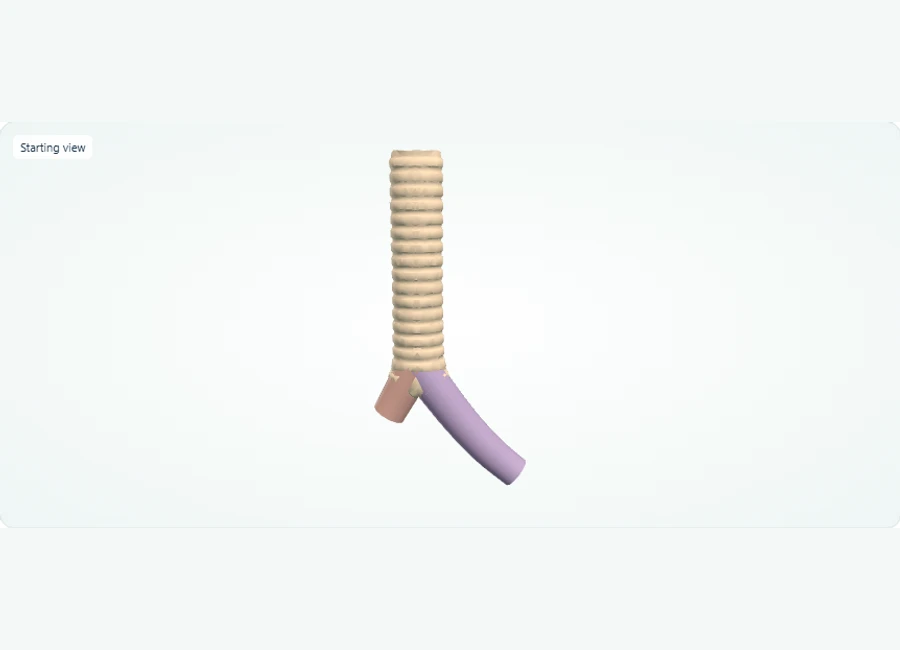
Rotate, isolate structures, and test your recall.
Set the view to front and zoom to see the whole model: the trachea is the single central tube, with the right main bronchus and left main bronchus branching from its lower end.
Select each of the three structures in turn (Trachea, Right main bronchus, Left main bronchus), using isolate to view one at a time and show all to restore the full model.
Use Test recall to hide the labels; when a structure is highlighted, name it before pressing Reveal name, then use Return to study to continue.
Try it yourself
Test recall highlights the structure branching from the lower end of the trachea toward the body's left side. Which structure is it?
Show answer and explanation
Left main bronchus
In the front view, the trachea runs down the midline and splits into two main bronchi. The branch passing to the viewer's right (the body's left side) is the left main bronchus, while the branch to the body's right side is the right main bronchus.
- The trachea is the central airway that divides into two main bronchi, one for each lung side.
- The right main bronchus and left main bronchus are the first branches off the trachea; this model contains no smaller (lobar) branches or alveoli beyond them.
- Because only three structures are selectable, identification practice here means telling the trachea from the right versus left main bronchus.
Airway and Ventilation: Interpreting Oxygenation and CO2 as Two Separate Questions
Separate oxygenation from ventilation when reading respiratory data. Pulse oximetry speaks to oxygenation; end-tidal CO2 and waveform shape speak to ventilation and circuit integrity.
Train yourself to ask two independent questions at any point in a case: Is the patient being oxygenated, and is the patient being ventilated? A normal saturation with rising end-tidal CO2 points to a ventilation problem rather than an oxygenation problem. A sudden loss of the CO2 waveform with unchanged saturations suggests disconnection, displacement, or loss of circulation before it suggests hypoxemia. Making this two-question split automatic is worth deliberate practice because the two data streams come from different sources and answer different physiological questions.
Then study the capnography waveform as a diagnostic shape, not just a number. A sudden drop to zero suggests disconnection or complete loss of exhaled gas sampling; a gradual sloping pattern is taught as a feature of obstructive or obstructed exhalation; a low plateau invites questions about hyperventilation or low cardiac output delivering less CO2 to the lungs. Practice deriving diagnoses from described waveforms aloud with the differential for each shape, so that reading a written description of a pattern becomes your routine route to the interpretation.
- Question 1 — oxygenation: saturation, inspired oxygen, lung factors
- Question 2 — ventilation: end-tidal CO2 value and waveform shape
- Sudden waveform loss: check connection, placement, and circulation before blaming the lungs
Hemodynamics: Reading Blood Pressure and Heart Rate as a Pattern, Not Two Alarms
Interpret hemodynamic changes as paired patterns: pressure plus rate plus trend together suggest a cause. Treat isolated single-value alarms as prompts to gather the pattern, not to act blindly.
Practice building a two-axis map: for hypotension and hypertension separately, list the paired states (fast/slow rate, and rising/falling trend) and one or two classic explanations for each cell. Hypotension with tachycardia suggests a different differential than hypotension with bradycardia; hypertension with tachycardia during maintenance raises the question of inadequate analgesia or light anesthesia per the triad discussion above. The pattern-first method turns a barrage of monitor alarms into a short differential list.
Worked scenario 2: fifteen minutes after induction, blood pressure falls and heart rate rises modestly. Mistake: immediately requesting a vasopressor and closing the loop. Better decision: run the systematic differential before intervening — assess anesthetic depth against recent drug administration, estimate volume status against blood loss and fluid given, check ventilatory factors that affect venous return, and only then classify the cause and choose support. Why it matters: mechanism-first reasoning is what distinguishes a defensible anesthetic plan from symptom suppression, and written cases give you the space to work that chain in full.
Neuromuscular Blockade: Depolarizing vs. Non-Depolarizing, and Why Reversal Logic Differs
Group neuromuscular blockers by mechanism. Depolarizing and non-depolarizing agents differ in onset profile, monitoring response, and which reversal principles apply, so reversal reasoning is not interchangeable between them.
Learn the two families as contrasting mechanisms: succinylcholine acts as a depolarizing agent with a characteristically rapid, brief course, while the non-depolarizing family (agents such as rocuronium, vecuronium, and cisatracurium) produces a graded, longer-lasting block that wanes predictably and can be antagonized. Study peripheral nerve monitoring — commonly described as the train-of-four concept, where four stimulation responses are compared — as the bridge between mechanism and bedside assessment of recovery.
Worked scenario 3: near the end of a case, a plan is made to reverse residual relaxation so the patient can be extubated. Mistake: treating reversal as automatic, regardless of which agent was used or what the monitoring shows. Better decision: identify the blocker family, interpret the train-of-four pattern as the measure of recovery, and connect antagonism to adequate spontaneous recovery rather than to the clock. Why it matters: in the clinical setting, extubation safety depends on the whole chain — knowing the agent's mechanism, reading the monitoring correctly, and judging timing from measured recovery rather than elapsed minutes — so rehearsing the intact chain is what makes your reasoning reliable.
Professional Standards: What the Assistant Role Adds to Documentation and Safety
CAA professional standards emphasize practicing under physician direction, complete contemporaneous documentation, and structured communication during handoffs and critical events. Study these as behaviors you can narrate, not as abstract ethics.
Frame the assistant role as an anesthesia care team membership question: know who is medically responsible, what tasks are delegated, and how that division shapes documentation. Hold every practice chart entry to one standard — an independent reader should be able to reconstruct what happened and why without asking. That means each entry carries the drug, dose context, timing relative to events, response, and the reasoning for a change of plan. Writing to that standard in study exercises builds the habit the role demands.
Convert safety standards into rehearsed verbal routines. Practice a fixed handoff script covering airway status, drugs given and still active, blood loss and fluid balance, ongoing issues, and anticipated problems. Practice closed-loop communication for critical events: the receiver repeats the instruction, the sender confirms. These are general professional-practice principles you can exercise on paper; the certification body's own materials govern the specific standards, so read them directly rather than substituting informal summaries.
- Documentation test: could an independent reader reconstruct events and reasoning?
- Handoff script: airway, active drugs, volume and blood status, concerns, anticipation
- Closed-loop communication: instruction, read-back, confirmation
A Case-Linked Study Sequence with a Self-Check Rubric
Study in four passes: build the fact base, then attach facts to cases, then vary the cases, then test under time. Use a rubric on practice scenarios rather than trusting a feeling of readiness.
A realistic adaptable sequence: Weeks one and two, build the fact base by family (induction agents, volatiles, opioids, relaxants) and the physiology pairs (oxygenation vs. ventilation, pressure-rate patterns). Weeks three and four, write one running case per day and force every fact into it. Weeks five and six, vary the cases — change one variable such as volume status or blocker choice and re-derive the plan. In the final stretch, work mixed question sets under time and review every miss against the case narrative, not just the answer key.
Practical exercise: take a standard adult induction and maintenance case from any question bank or your own writing. Score it with this rubric, aiming for these as learning milestones, not pass predictions: (1) every drug is labeled with its triad target and one physiologic cost; (2) every monitoring change is classified as oxygenation, ventilation, or hemodynamic with a differential of at least two causes; (3) the plan names what would change the decision — readiness check: you can state a change-of-plan trigger for each drug and each monitor without notes. A blank on any line is your next study target.
- Pass 1: fact base by drug family and physiology pair
- Pass 2: one running case per day, facts embedded
- Pass 3: change one variable, re-derive the plan
- Pass 4: timed mixed sets; review misses through the case lens
References and further reading
Use these references to explore the concepts and check the latest information from the relevant organizations.